
Audi and OLEDWorks have marked ten years of production automotive OLED lighting. The more interesting milestone is how a uniform light panel has become a programmable rear-end interface.
AUTOMOTIVE LIGHTING / OLED / SOURCE DATE: 23 October 2026
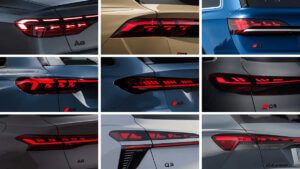
The production milestone
Audi and OLEDWorks marked a decade of OLED lighting in production vehicles on 23 October, following an industry gathering in Ingolstadt on 15 October. The anniversary is more than a birthday for a particular rear-lamp technology. It traces the passage from thin, uniformly illuminated panels to individually controlled lighting elements capable of carrying recognisable brand signatures and, in defined situations, warnings for other road users.
The first attraction was visual. An OLED panel produces a broad, even luminous surface without the familiar points of light associated with discrete LEDs. That allowed designers to draw illuminated forms rather than conceal a light source behind increasingly elaborate optics. For a premium manufacturer, the opportunity was to make a rear lamp appear as deliberately designed in darkness as the bodywork does in daylight.
From appearance to information
The more significant change came with segmentation. OLEDWorks points to the second generation of digital OLED rear lights in the Audi Q6 e-tron, developed with Audi and Marelli, as a step towards selectable signatures and vehicle-to-environment communication. Instead of one panel performing one fixed visual task, groups of controllable segments can be orchestrated to show approved patterns and specific hazard indications. That shift changes the engineering brief. A lamp is no longer only an optical assembly that must satisfy brightness, visibility and colour requirements. It also needs electronics, software logic, diagnostics and safeguards governing which content may appear in which driving state. Personalisation must coexist with mandatory signalling functions. A warning graphic that looks persuasive in a design studio still has to be legible, unambiguous and legal on the road.
Curves, packaging and qualification
The next frontier is the three-dimensional body surface. OLED-Info reports that the recently launched Audi Q9 uses curved digital OLED rear-light panels, allowing illuminated sections to follow the vehicle’s corners. The independent report gives a figure of 512 controlled segments across six panels. Those details should be checked against final Audi homologation and technical material before being treated as definitive product specifications. Curvature creates new opportunities for side visibility and distinctive styling, but it also raises practical questions: substrate stress, encapsulation, moisture protection, thermal cycling and replacement cost. A thin light source does not automatically produce a thin or inexpensive lamp assembly. The surrounding structure,
electrical connections and environmental protection can dominate both the package and the bill of materials.
The commercial test
OLED lighting now has to demonstrate more than premium appeal. Vehicle makers will weigh optical quality and design flexibility against the cost of segmented drivers, software validation, end-of-line inspection and field service. Suppliers must also show that decorative features can survive the same demanding lifetime and warranty expectations as conventional rear lamps.
There is a broader market signal here. Marelli’s own 2026 presentation combines OLED with other surface-lighting approaches, suggesting that future lamps may mix technologies rather than choose one universal winner. OLED may be best for a particular surface or pixel size, while microLED, light guides or thin printed systems solve different constraints.
The Lux View
Ten years of road use have turned OLED from a styling experiment into a credible component of digital vehicle architecture. The winning feature is not simply that the light is thin or beautifully uniform. It is the ability to make a regulated exterior component serve design, personalisation and carefully bounded communication at once. The next decade will be decided by the less glamorous measures: cost per usable illuminated area, reliability at the edges and corners, software assurance and ease of repair.
Publishing information
Source and research links
https://www.oledworks.com/news/10-years-of-oled-lighting-in-production-vehicles/
http://Independent context: OLED-Info report, 24 October