
The 2026 safety tests reward accessible controls for essential functions. For smart-surface designers, the message is not to abandon digital interfaces but to choose the right interaction for the task.
AUTOMOTIVE HMI / SAFETY / SOURCE DATE: 12 October 2026 (catch-up)
Safety scoring reaches the interface
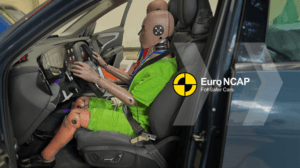
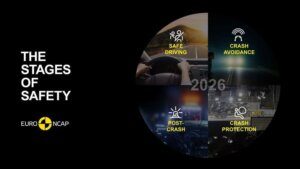
Euro NCAP’s 12 October release on its latest 2026 vehicle assessments gives an unusually direct answer to a long-running cockpit debate: for essential driving functions, physical controls still matter. The organisation highlighted the Audi Q7 and Kia EV2 for accessible switches and stalks, while criticising the XPENG X9’s reliance on a central touchscreen for basic operations. This is not a ban on touchscreens and it is not a finding that one vehicle is broadly unsafe. All three vehicles received five-star overall ratings. The distinction lies within the safe-driving assessment, where Euro NCAP now examines how easily a driver can operate functions such as indicators, wipers, washers, hazard lights, horn and the emergency-call button.
The difference in the numbers
Euro NCAP reported a 90% overall driving-controls score for the Q7, including full marks for essential driving tasks and 80% for comfort and infotainment. The XPENG X9 scored 20% for primary driving controls. These figures do not directly compare the vehicles’ entire safety performance; they describe a specific aspect of the human–machine interface. The organisation’s revised 2026 protocols also examine control placement, clarity and ease of use. The point is not that a mechanical button is intrinsically perfect. It is that an immediately identifiable, directly operable control can reduce the need to navigate menus and divide attention during time-critical driving tasks. A badly positioned button can still be poor HMI.
A useful boundary for smart surfaces
Automotive interiors are moving towards hidden switches, illuminated icons, haptics and decorative surfaces that become active only when needed. Those technologies can reduce clutter and allow designers to integrate functions into door cards, consoles and trim. The Euro NCAP results make the distinction between discretionary and essential interactions more commercially important. A seat-massage setting, ambient-light colour or entertainment menu can reasonably live behind a digital interface. A hazard warning switch is different. Drivers may need to find it immediately, without looking away or waiting for an animation to reveal the control. The design problem is therefore not screen versus button, but which functions need tactile certainty and which benefit from flexibility.
What should suppliers demonstrate?
For suppliers of touch and smart-surface systems, the evidence package needs to go beyond visual integration. Engineers should be able to show target size, activation force, accidental-touch performance, glove operation, latency, illumination in bright sunlight and darkness, and how the control behaves when the display or communications network fails. Haptic confirmation may help a driver know an action has registered, but it does not automatically solve the problem of locating a control. Equally, a permanently visible illuminated symbol can improve discoverability without requiring a protruding switch. The right solution may combine a physical input, a clear light cue and software-defined secondary functions.
The Lux View
This is a useful correction to the idea that the most sophisticated cabin has the fewest visible controls. Smart surfaces remain valuable, but their success will depend on a disciplined hierarchy of interaction. The best interface is the one that helps a driver act correctly with the least thought. If that requires a simple switch, advanced engineering should make room for it. This is a practical design constraint, not nostalgia.
Publishing information
Source and research links