Audi’s new flagship SUV uses curved digital OLED rear panels and projected road guidance to make exterior lighting more expressive — and potentially more useful.
Source date: 23 October 2026 | Status: Production vehicle
A new shape for the rear lamp
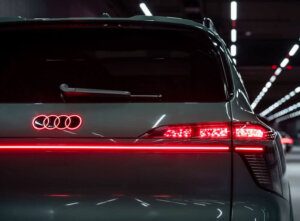
Audi has announced that the new Q9 will bring three-dimensionally curved digital OLED panels into a production vehicle. That is a more significant design change than a new lamp graphic. Rather than fitting a flat illuminated element behind a sculpted lens, Audi is shaping the emitting surface itself to follow the body. Its stated advantage is improved visibility from the side, alongside greater freedom for designers working around the rear corners of a large SUV.
From signature to information
The Q9’s rear lamps comprise six digital OLED panels with a combined 512 individually addressable segments. Audi identifies one curved panel with 99 segments as its largest automotive OLED panel to date. The vehicle offers up to eight digital light signatures at the front and rear, including a new semi-active presentation. In practical terms, the same physical assembly can present different patterns without requiring a different outer lamp architecture. That is attractive in a premium segment where differentiation and personalisation have commercial value.
What the driver actually sees
The more consequential development is at the front. Audi says the Q9 combines its rear OLED system with digital Matrix LED headlamps capable of projecting useful guidance onto the road. Its described functions include lane illumination, orientation markings and a dynamic turn-signal projection at night. In roadworks or narrow lanes, the system can adjust its distribution to help drivers judge the available space. These are driver-assistance lighting functions rather than entertainment graphics, and Audi notes that they operate within defined system limits.
The engineering beneath the effect
The headlamp module uses 25,600 micro-LEDs in an approximately 13 mm-wide array, according to Audi. That figure matters because it enables the lamp to control where light falls with much finer resolution than a conventional segmented beam. But it is the integration of optics, sensors, control software and legal lighting functions that determines whether the customer benefits. A technically impressive pixel count is of little use if projected markings are difficult to read in rain, compete with road paint or distract other drivers.
A broader shift in exterior design
Curved light-emitting surfaces also change the package-engineering conversation. Lamp designers must reconcile styling curvature, thermal management, sealing, serviceability and repair cost. Digital signatures introduce software validation and market-specific regulatory questions. The Q9 is therefore a useful production case study: it places programmable light in the exterior body architecture rather than treating it as a decorative accessory. It also raises a question for premium brands about how many selectable signatures are genuinely useful, and how many simply add complexity.
What to watch next
The next useful evidence will come from owner-facing demonstrations and independent night-driving assessments. In particular, the visibility of projected guidance in wet weather, the consistency of signature brightness at oblique angles and the ease of replacing a damaged rear assembly will determine how the technology performs beyond its launch. Availability may also vary by market and equipment grade, so the announcement should not be read as a promise that every Q9 will offer every function.
The Lux View
The Q9 makes a convincing case for lighting as both identity and information. Its most important advance is not that an OLED can bend, or that a headlamp contains thousands of emitters. It is that Audi is using those capabilities to deliver visible functions on a named production vehicle. The commercial test will be whether owners value the communication features after the initial novelty of the animations fades.
Publishing information
Source and research links