
A European flexible-heater demonstrator replaces printed silver with dry-patterned metal foil. It
shows why the next smart interior may be decided as much by process economics as by design.
SMART SURFACES / MANUFACTURING / SOURCE DATE: 19 October 2026
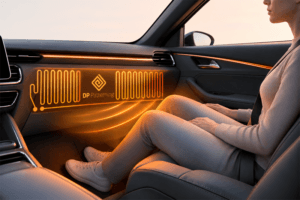
A functional surface, not another heater box
DP Patterning, Avery Dennison and IUMAT announced a flexible heating demonstrator for vehicle interiors on 19 October, with its first public showing scheduled for the TechBlick exhibition in Berlin. The proposition is straightforward: place heat where occupants actually touch the cabin, and manufacture the conductive layer in a repeatable European roll-to-roll process rather than building it around expensive printed silver or chemical etching. In an electric vehicle, cabin comfort competes with propulsion for stored energy. A heated door panel or armrest can warm a person directly, rather than relying entirely on the ventilation system to raise the temperature of the cabin air. The partners cite a Ford electric-van field test that recorded a 13% reduction in
heating energy using heated interior surfaces. That is useful context, but it is not a measured performance claim for the new demonstrator.
Why the metal pattern matters
The circuit uses DP Patterning’s Dry Phase Patterning process, which mechanically patterns aluminium or copper-clad aluminium laminates. The company says the method avoids etching chemistry and produces conductive structures with closely controlled resistance. In a heating application, resistance consistency is a production parameter, not a cosmetic preference: it influences temperature uniformity, power demand and the risk of local hot spots. Printed silver remains useful in many functional films because it can follow complex geometries and be deposited selectively. But silver price volatility, curing requirements and resistance variation can undermine the economics of a large-area heater. Solid-metal patterning offers a different balance of material use, conductivity and process complexity. The right answer will depend on geometry, bend radius, connection method and required production volume.
The adhesive is part of the circuit
Avery Dennison contributes a solvent-free transfer adhesive, FT 21502, intended to bond the patterned heater onto curved cabin surfaces. It also supplies a cover tape for the electrical connection. IUMAT designed the heater circuits and integrated the demonstrator after laser cutting the patterns. That division of work matters because a flexible electronic product is not just its conductive artwork. Adhesion, insulation, strain relief and the transition from flexible film to wiring often determine whether the assembly survives a vehicle programme. The partners claim their production route can cut process carbon emissions by up to 98% and that the adhesive platform reduces production emissions by 19–30% against a solvent-based alternative. Those figures are
supplier-reported comparisons. A proper OEM decision would need the boundary conditions, energy mix, scrap assumptions and any impact on repair or recycling.
From show sample to serial part
The demonstrator is intended to be manufacturable at automotive volume, but the announcement does not establish a production nomination or a complete environmental qualification. An OEM would still want temperature mapping, cycling under load, peel strength after humidity exposure, electrical isolation, flammability performance and abuse testing. There is also the question of what happens when a door card is scratched, bent or removed for service. For designers, the interesting possibility is a cabin surface that can combine heat with sensing, illumination or decoration. For engineers, that combination introduces competing layer requirements: a decorative finish must transmit or conceal light, a heater must move energy into the occupant, and an electronic circuit must remain stable over time.
The Lux View
The value of this announcement is its emphasis on a scalable process, not an extravagant concept rendering. The industry already knows how to make a warm surface. The challenge is making thousands of identical, safe, low-cost warm surfaces that can be bonded into real interiors. Smart-surface suppliers who can explain resistance tolerance, material cost and environmental reliability will have a stronger case than those offering only visual novelty.
Publishing information
Source and research links
http://techblick.com/innovations-day/the-future-of-electronics-reshaped-2026