
New research uses thin-film lithium niobate to modulate red, green and blue laser light electrically. The results point to smaller optical engines, but not yet a finished consumer product.
OPTICS / DISPLAY TECHNOLOGY / SOURCE DATE: 19–21 October 2026
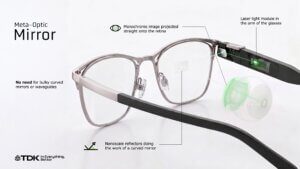
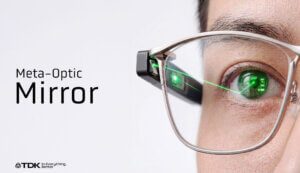
A different way to make an image
A research team led by Yasuhiro Takagi at TDK has demonstrated a photonic integrated circuit that controls the intensity of red, green and blue laser light using voltage rather than repeatedly changing the current through each laser diode. The work was reported in Advanced Photonics Nexus and covered by SPIE on 21 October. Its immediate application is laser-scanning displays for smart glasses, where image quality, size and power consumption are locked in an unusually tight compromise. A scanning display builds an image by steering a beam rather than illuminating a conventional grid of pixels. The approach can reduce the bulk of the image source, but it needs very fast, precisely synchronised control of the three primary colours. Direct modulation of laser-diode current can constrain that speed and can also require the lasers to operate at a current level that wastes power.
What lithium niobate contributes
The new circuit uses thin-film lithium niobate, a material whose optical behaviour can be altered by an electric field. Three Mach–Zehnder interferometers independently modulate the red, green and blue channels. Waveguides then combine them into a single output beam, which the researchers integrated with a microelectromechanical scanning mirror. In laboratory testing, the chip achieved a reported modulation bandwidth of 10 GHz. The researchers argue that this is sufficient to support the colour-switching demands of 4K-class laser scanning. They also report an overall power reduction greater than 75% against the conventional modulation approach evaluated in their experiment. Neither number should be read as a specification for a shipping headset.
The engineering obstacles remain
The device moves complexity from laser-current control into an optical circuit, but it does not make optical losses disappear. Coupling light into the waveguides, combining the colour channels and extracting a useful beam all consume part of the available optical budget. The research team identifies further loss reduction as a priority. Packaging the photonic chip, laser sources and scanning mirror into a reliable miniature engine is a separate challenge. There are also eye-safety, alignment and thermal constraints that a bench demonstration cannot resolve alone. Smart glasses are worn close to the eye, subjected to movement and temperature changes, and expected to remain visually comfortable. A high-bandwidth component is valuable only when the surrounding optics and electronics can exploit it safely.
Why automotive engineers should watch
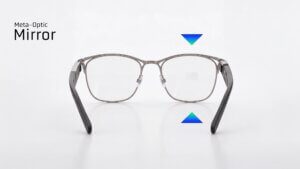
The crossover is not that this chip will automatically appear in a head-up display. Automotive projection has different requirements for brightness, eyebox, environmental life and certification. The transferable idea is architectural: moving optical modulation into a compact integrated circuit may change the size, efficiency and flexibility of future projection engines. TDK has separately demonstrated a meta-optic mirror for direct retinal projection, announced earlier in October. That is a different prototype, not part of the same integrated commercial product. Taken together, the research illustrates the industry’s search for optical engines that use less space without relying on ever larger display modules.
The Lux View
The most interesting projection advances increasingly happen inside the optical path rather than on the visible screen. Voltage-controlled colour modulation is a credible laboratory result with clear engineering questions still open. For vehicle HMI and compact projection suppliers, it is a technology to track for efficiency and packaging, not a reason to redesign a production dashboard tomorrow.
Publishing information
Source and research links